Showing posts with label Blood Donations. Show all posts

Thursday, 8 August 2024

My years of blood donation posts have done some good

I have been a blood donor since I turned 16. I had a gap of about eight years when I was often in malaria areas with adventure races, which is cause for deferral. I regained my regular donor status in 2008 and have retained it since.

I usually post here and on Facebook after donations, encouraging friends and readers to only donate if they intend to go back again at least three times within a year. The reason for this, in South Africa at least, is that your plasma (the other components are discarded) is quarantined after your first donation if it passes various tests - like for HIV and hepatitis. When you return and the tests on your second donation are clear, the plasma from the first donation is used and the second is quarantined. The same happens when you return a 3rd time.

It is only after you are clear of various transmissible diseases three times within a 12-month period (you can donate up to six times a year, every 56 days) that your red blood cells, white blood cells, platelets and plasma are used.

As such, once-off donations are a waste of time, resources, labour, testing, freezer space, money, and blood because your donation will be discarded after a year if you do not return. The marketing around blood donation always says that each donation saves three lives. It only serves this purpose if you donate regularly so that all of your blood components are used.

I went to donate yesterday.

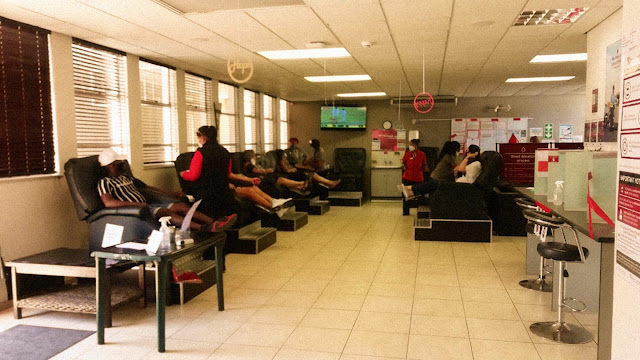
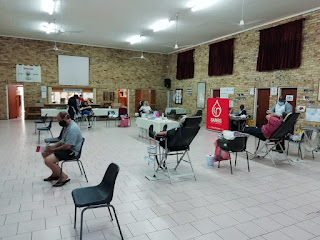
Watching Olympics at the George Western Cape Blood Service branch. My timing wasn't great as I got powerlifting instead of something like athletics, but it was interesting to see. 

My oldest friend David - we met at nursery school when I was 2 and he was 3 - responded with this:

"You’ve successfully persuaded me (after 20 years of making these valuable posts) to try again in the UK - they didn’t want it when I first moved here but this time they did - been used at Charing Cross hospital already. Just saying so you know your adverts work."

He is booked for his next donation in three-months time. 

Wednesday, 8 May 2024

Once-off blood donations are not used (you have to donate again)

I had been meaning to get to my local blood donor centre for weeks. They're open only on Wednesdays and Fridays. The WCBS Blood Donor Centre was a hive of activity after a call-out for donors was shared. As many of you many know, a building that was under construction collapsed here in George on Monday afternoon. 39 of the 75 people that were working on and in the building when it fell down are unaccounted for (7 of the 36 retrieved are dead). 


This town of George has been amazing with people volunteering in every and any capacity - from donating food and beverages for the rescue workers, providing emotional support for the waiting family members, contributing safety equipment, helping to remove rubble, and preparing meals for the 150+ people, including police and medical personnel, on site throughout the day and night. The volunteer support has been amazing, but it has also been understandably overwhelming for those dealing with this on the ground. 

Today's call-out for blood donors was made with good intentions by someone. I learned at the Centre that blood stocks were actually good (shared somewhere said stocks were critical) and both the Centre and a school's blood drive, planned before the disaster, were inundated with donors. While wonderful, it is also a challenge. 

There is something else too (and I'll say it again and again)... Once-off donations are not used. When you donate for the first time, your blood is tested and then separated into components, and your plasma is frozen and stored. When you go back a second time and your tests are clear again, they use the frozen plasma and store your new donation. When you return a 3rd time and your tests are clear, they use the second donation. These three donations must happen within a 12-month period (you can donate up to 6 times a year). Only once you have a 'regular donor' status will all of your blood components be used. The reason they do this is to ensure that you are healthy and that there is no risk to the recipient. 

Also, when you donate, whether in a disaster situation or not, you can't choose who your blood must go to. It goes to the blood bank and will be given to whoever needs it, whenever it is needed. 

To all those people who kindly donated today: please go back in two months time and donate again. And then go back in another two months. What SANBS and WCBS need is to have more regular donors throughout the year, and year after year.

Thursday, 6 April 2023

My heart rate is always on a go-slow

Blood donation. 2nd one for this year. Western Cape Blood Service is in need of blood, especially from O blood groups. As an O-negative universal donor, my blood is in high demand.

I have a naturally low heart rate. It has always been low whether I'm super fit or just regular fit.

When they took my blood pressure, the machine logged me at 47bpm. This is not unusual for me but the lady was concerned. She sent me to have a juice and then tested again about 5 mins later. 53bpm. As long as the person's pulse is over 50, it is good to go. With thanks to my strong, beating heart, I filled the bag in 5:30. Another pint logged.

My slower than normal heart rate has a name - bradycardia. I've never been diagnosed but this name applies to a slower-than-expected heart rate of fewer than 60 beats per minute.

I have never had any symptoms of any underlying disease and I don't suffer from fainting, fatigue, dizziness, weakness, chest pain or difficulty breathing. I can remember taking my pulse during lectures at university and it would usually be in the 38 - 42bmp range.

A bunch of years ago - more than 10 - I went for an ECG, which was compulsory for a staged ultramarathon. At 08h30 in the morning, after having breakfast, driving to the doctor's office and getting hooked up to the machine, my heart rate was recorded at 35bpm!

Causes of a slow heart rate include genetic (family history), high level of fitness (I'm fit but not high level), meditative breathing (which I rarely do), and medication side effects (I'm not on any meds). Bradycardia can be caused by illness - an infection, low thyroid function, electrolyte imbalance, and too much potassium. Also diabetes, high blood pressure and congenital heart defects. I have none of these and no symptoms.

I need to poll my uncles on my dad's side because I'm sure I recall one of them mentioning many years ago that they have always had a slow heart rate. This leads me to think it is familial.

Whatever it is, I'm blessed to have a strong heart that allows me to do the activities that I do.

Friday, 14 October 2022

Back in the blood donation seat

When I last went to donate blood in March, I had my first vasovagal episode during a donation - and this is after more than 60 donations since I started donating blood at 16. The needle wasn't put in right, it kept blocking and the jiggling around of the needle was the trigger. I felt the fainting coming on and said to the nurse I wasn't feeling great. I must have gone as white as a sheet and in seconds they had a fan in front of me, smelling solution under my nose and I heard someone say, "She's back".
 
Today, I was back in the seat with a like-clockwork donation, filling the bag in less time than it takes to make a cup of tea.

When I relayed the situation of my last donation to today's nurse, she said, "It is the jiggling that does it".

Although the blood donation marketing campaigns say that every donation saves three lives, this only holds true if you are a regular donor; when you donate 3 to 6 times a year. For your own safety and that of the blood recipient, if you do not go back again and again - three times every year, your donation is not used. Donating blood is an awesome thing to do but don't waste your time, their time and resources, and your blood if you do not intend to go back at least another two times in a 12-month period.
 
The donation process is on WCBS and SANBS websites, but not as direct as I'm telling you here. They're all about campaigns and getting new donors in who they hope will come back because of the good experience; I'm all about education and getting well-intentioned, once-a-year / blood drive-only donors to become committed, regular donors so that each donation really will save three lives.


Wednesday, 16 March 2022

I nearly dropped like a stone

 I've been a bit behind on my blood donation schedule. The George blood donation centre is open on Wednesdays until late so I headed there after work to give a pint.


It usually takes longer to complete the questionaire, have the iron-level finger prick and then blood pressure taken than it does to fill a bag. My actual donation time is 4:30 to 6:00. Boom. Just like that.

Today was different.

Ahead of me was a newbie and she was sitting in the chair next to me. She did good. I was going to give her my 'Once-off donations don't count - you have to come back again and again' lecture, but I held back. Instead I sat back nice and comfy in the La-z-boy style chairs.

After a few minutes the nurse came to me, checked my details and got the bags ready. I had a feeling that she was the setup one and that another would do the actual jab. She then came back and did the jab, which was fine but the angle of the tube made the needle pull against the skin where it went into my arm. A bit uncomfortable. I figured I'd handle it for the next few minutes but while she was filling the little bag and vials (used for various tests) it got more uncomfortable. 

She then switched the tubes over from the one that fills the vials to the one that fills the big bag.

Nothing happened.

She checked the pipes, wiggled the connection. Nothing.

She then checked the needle, withdrawing it slightly. Blood started to flow again. I asked he to re-tape the tube at a better angle to relieve the niggle, which she did. While doing this the machine started to beep that the blood flow into the bag was too slow.

Me? Too slow? Never! 
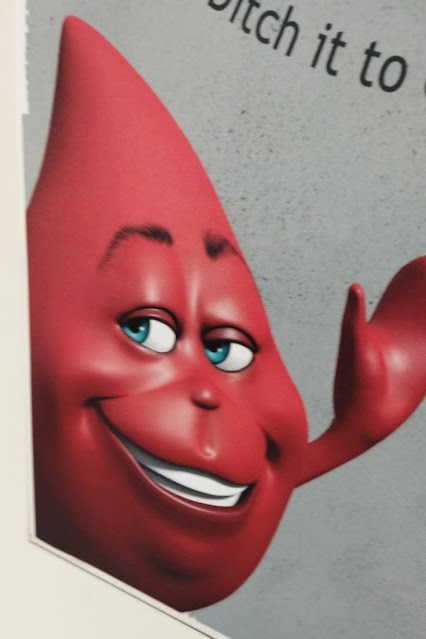
Naughty blood drop guy in the WCBS donation campaign. The campaign is all about this guy skipping a work out, work meeting or homework to go off to donate blood.

There was another blockage. Thinking that the needle was now in too shallow, she moved it deeper into the vein (a super, fabulous vein) and the flow picked up again. And then it stopped. She adjusted it outwards more. It flowed and then stopped again.

She then called another nurse to come check this out.

She had asked me twice in this process - a period of probably no more than 2-3 minutes - whether I was Ok. And I had been.

But then, I suddenly started to feel queasy. That limbo between being ok and being unconscious when colours dim, sounds distort and you don't think so good.

The other nurse was almost with me and I told 'my' one, as she turned to move away, "I'm feeling really queasy".

I'm not sure how it all went down but in an instant there was a guy to my right giving me a piece of cotton wool with something smelly on it (smelling salts?) and he told me to sniff it. He (or someone else) told me to cough (a few times). And breathe. And in these 30-seconds the needle was out and a big fan was in front of me. I don't remember the fan being brought forward.

Did I hear someone say "You're back with us"? 

If I did pass out, I don't think it was for more than a second or two. 

It's a good thing that I was sitting in the comfy chair because if I was standing I would have dropped like a stone.

I've done a few over 60 donations over a period of almost 30 years* and this is my first experience of this happening to me at a blood donation. 

* My average is not two donations a year. I missed about eight years of donations with lots of travel and being regularly in malaria areas. At the age of 16, I did my first donation at my high school's mobile donor clinic, which visited us each term.

But, this is not the first time that this has happened to me overall.

In my postgrad years at university, I would volunteer for the physiology postgrad experiments. 

There was this one where I was to ride a stationary bike and they would draw blood at intervals as the intensity increased.

I was ready and on the bike. Someone put one of those butterfly needles into my left arm. This would allow them to attach vials to the tube to draw blood without disturbing me and without causing me any discomfort other than the initial needle prick to insert the needle. Easy.

I can't exactly remember but I recall helping the lady to tape down the tube. There was something not right and the taping had to be redone. Like today, I was intently focused on the task, watching what was going on and trying to assist using my right hand.

Whatever it was, the world went shades of grey and sounds got distorted like I was in a fishbowl. I told them that I wasn't feeling well. I got off the bike to sit on the floor. One of them suggested I sit on a nearby seat. I recall being helped off the ground and guided between two people. And then I wasn't. I came to in seconds, lying on my back on the floor, looking up and seeing panicked people running around. I spoke to them to tell them I was fine and a few minutes later I was really fine - walking and talking again. 

Needless to say, they didn't continue the experiment on me even though I was willing. The poor student was so shaken.

This is all so strange for me because even then I'd been a regular blood donor for at least six years. I'm another 20-odd years down the line. I've never had needle phobias, vaccinations are barely a beep on my radar, and I'm generally drawn to wounds, blood and any other medical issues. I'm the person they call at the factory if someone has an injury that needs cleaning and bandaging. I take out stitches from my pets, other people and myself. Squeamish, I am not.

That said, it does look like I have a trigger. Two similar situations around 24-years apart. The same reaction. So silly. I now know that I cannot assist other people to do medical things to me. Yes, that means that if if something happens to me in the middle of nowhere, I'm likely to pass out if I try to assist someone to stitch my wounds or take out my appendix. 

Thankfully, you're in luck if something happens to you. I'll be the first one on the scene to get a piece of the action.

Even though I barely made a 1/4 bag today, I can only make another donation in another 50-odd days. I've still got enough time to do 3-4 donations this year to maintain my regular donor status.

Thursday, 21 October 2021

Blood donations save lives, BUT

 Blood donation time again. I'm a bit off schedule but this logs my 3rd for the year (and 3rd for Western Cape Blood Service), maintaining my regular blood donor status. I'll get in a 4th around Xmas-New year, which fits in with my annual habit.

Blood is always in demand and it does save lives. BUT, only donate if you intend to donate at least THREE TIMES a year. Once-off donations and those done only once a year ARE NOT USED. You have to go back a second and a third time for just your plasma to be used. Continue donating blood 3 to 6 times a year to maintain your regular blood donor status.

Look online at the SANBS and WCBS websites for details on bloods drives, mobile and permanent clinics in your area. If you're outside of South Africa, you'll have a donor organization on your side.

Friday, 30 April 2021

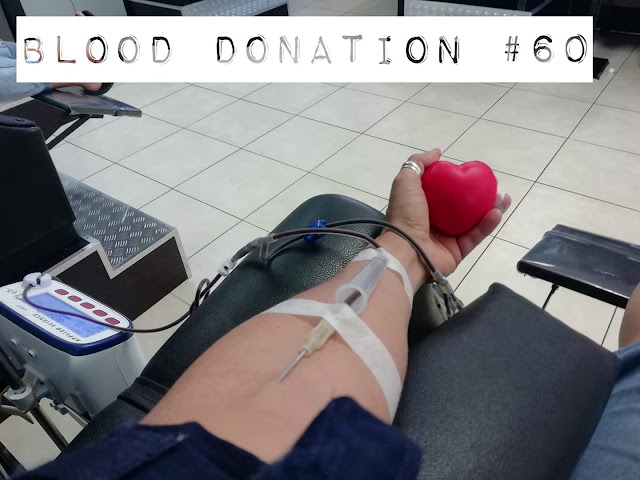
Blood Donation #60

Blood donation #60 in the bag. 

My second donation with Western Cape Blood Service at their plush and comfortable donor center in George. My donor record was transferred from SA National Blood Service, which is where I first began donating blood at the age of 16 at the mobile clinic that visited our school. 

With my 60-donation milestone now reached, it is onward to 70, which I should make in 2 to 2.5 years.

Sunday, 21 February 2021

Moving to the Western Cape Blood Service

On moving to George, I learned that SA National Blood Service (SANBS) doesn't cover the whole of South Africa! The Western Cape Blood Service (WCBS) takes care of my new home province. 

Today, I made my first donation at the WCBS donor centre in George - and an excellent experience it was! For five years, I've been used to the mobile clinic that visited a church hall in Parys. Here, the centre has plush chairs and an established vibe. The staff were superb and just as friendly as those from my Parys clinic. My donor records will be transferred as I work my way towards milestones. Today's experience was clearly exciting - I set a new bag-filling record of 4:37. With much sought after O neg blood, I'm an overachiever blood donor.

Just remember, once-off and annual 'feel-good' donations are.not.used! You get a 'regular blood donor' status by donating 3 to 6 times a year. Only then will your trusted donation be used. The blood services never spell this out clearly with their 'One donation saves three lives' message but you'll find the procedure on the FAQ page on the SANBS website. If you can, donate - regularly!

Tuesday, 14 July 2020

Successive blood donations give you a proven track record

 Blood donation day today. The mobile clinic visits Parys on the second Tuesday of every month and it is always a pleasure to see them. 

Donors can donate every second month with a max of six donations a year. To be a regular donor, you need to donate at least three times a year. Having a regular donor status ensures that all your blood components are used.

Once-off donations may leave you feeling like you've made a contribution to the blood stores - but you haven't. Your blood will not be used unless you go back twice more within a year. Go back and donate again and again.

Successive donations give you a proven track record of safe blood. I'm quite sure that if you were on the receiving end, you appreciate that you receive safe blood from donors who prove their health and safety multiple times a year. As a donor, this is your responsibility.

Tuesday, 12 May 2020

Donating blood with social distancing for #55

 Spaced queues, chairs and stretchers at today's monthly mobile blood donor clinic by SANBS in Parys this afternoon. 

As always, a good vibe and friendly staff and donors. 

#55 for me today. "Oppad na 60," said the blood pressure-testing lady.

* translated from Afrikaans - "On the road to 60".

Wednesday, 13 February 2019

Mobile blood donor clinic - "Parys never disappoints"

On the second Tuesday of the month, SANBS visits Parys with their mobile blood donor clinic.


The staff always say "Parys never disappoints" as they usually have over 100 donors every month.

Yesterday, the hall was packed. As luck would have it, they were low on staff (those absent were off ill) and as such they only had six instead of eight beds. While I was there the beds were always occupied. The queue for blood pressure and iron check was full (about 15-18 seats) the whole time and before I got to a bed there were seven of us in the bed queue. I got there at 4pm and was out a bit after 17h30 - I'm usually in-and-out within 30 minutes.

They were expecting 140 donors. Well done Parys.

This was my 51st donation - Rusty comes with me.

REMEMBER: once-off donations are a waste of time, resources and blood. If you are going to donate, you need to become a regular donor and maintain your regular-donor status for your blood to be used. To be a regular donor, you must donate at least three times a year (max is six times - every two months).

Thursday, 13 September 2018

50th blood donation milestone

On Tuesday evening, I reached my 50th blood donation milestone.

I started donating blood at 16, the age at which people are permittes to donate blood. We had a mobile clinic that came to our school a few times a year.

At university, I initially went to the permanent clinic at Eastgate and then later, for my postgrad year at medical school campus, I would donate at the hospital clinic. 

Once I started adventure racing, I was often in malaria areas, which is an exclusion, and so I got out of donating for the better part of a decade plus.

It was only when I organised a blood donation drive at a company where I was working in mid-2008, that I regained my regular donor status by donating at least three times a year for the last 10 years.
I left the company shortly after our successful donor day and settled in at the Bruma donor clinic. For three years, I have been a regular at our Parys mobile clinic. They come to town on the second Tuesday of every month. 

As I have done four donations already this year, I recieved a lovely picnic backpack from SANBS. Their gifts are definitely a lot more frequent - probably to encourage donors. I have used many of the thoughtful gifts over the years (the first coolerbag was a winner and I'm currently enjoying the second edition) and I have given away others - like the cosy scarf and beanie that I received this winter; it went to our gardener.

If you can donate blood, do it. If you are excluded for some reason, it is not because they don't want your blood. It is because donating poses a health risk to you or the recipient.

Also add to your list to register as an organ donor. When you die, you won't be needing those organs and they'll change the life of someone who needs an organ. While you're at it, sign up for the bone marrow registry too. Even if you feel squeamish, just do it. You may be on the receiving side sometime and what a bugger it would be if you had a match out there who could save your life but they didn't register because they 'don't like needles'. Really? 

Blood donation is easy and doesn't take much time. Stock levels are always low. 


If there is anything that I have taught you from my posts over the years about blood donation it is to become a regular donor - safe for you and the recipient of your blood . 

They don't use your blood if you make a once-off donation. You MUST donate at least 3 times a year (max is 6).

What are you waiting for?

Tuesday, 10 April 2018

Blood donation - working my way to 50

Today was my 47th blood donation; by the end of the year I'll be on 50.


As always, my reminder to you that if you donate blood, please do so regularly. By this I mean that in order to maintain your 'regular donor' status, you need to donate at least three times a year (max 6 times).

The whole point of being a regular donor is so that your whole donation is used because you are a trusted donor whose blood has been tested each time and has been clear of HIV and hepatitis (and other infectious agents) each time. As a recipient, your mind would be at rest knowing that the blood you receive is from a trusted source.

Here's how the blood donation process works:

  • You donate blood for the first time (first time ever or first time in a long time - same thing) .
  • Your blood goes through the tests and then sits on ice.
  • You go in a second time a few months later. 
  • Your second donation goes through the tests and if it is clear, this donation goes on ice and the plasma from your first donation is used. 
  • You go in a third time WITHIN A YEAR. 
  • This donation goes through the tests and if it is clear, then it will be used, together with the plasma from the second donation. 
  • Thereafter you need to maintain your regular donor status - your whole blood from every donation will be used.
If SANBS defers you from donating, do not see this as a form of rejection. Their objective is to ensure that blood donation is safe for BOTH donor and recipient. This is why they will not let you donate if you have conditions like diabetes or blood pressure and heart issues, if you take certain medications, if you have recently been in a malaria area or if you have low iron levels (and various others). 

If you cannot donate for any reason, you can still be supportive of blood donation by encouraging able friends and relations to donate and by educating anyone and everyone about the importance of becoming a regular donor and maintaining your status by donating at least three times a year, every year. 

Thursday, 15 June 2017

Proud of my blood-donating townsfolk

I'm really proud of my little town.

SANBS comes to Parys on the second Tuesday of every month. Whenever I go (every two or three months) to our mobile clinic I always ask how the participation has been.

Without fail the answer is, "Parys never lets us down".

Yay! for our townsfolk.


Wednesday, 8 March 2017

Back to my blood donation schedule

In early December I went to donate blood at our regular mobile clinic here in Parys. I was deferred (not allowed to donate) when a drop of my blood failed the haematocrit test, which is done every time before you donate.

The test is nothing more than taking a drop of blood from a finger prick and dropping it into a container of copper sulfate. The drop of blood is required to sink to the bottom - if it floats or hovers to descends too slowly, you fail. I've failed the test a number of times over the years but when this happens, the clinic takes another drop and runs it through their testing machine (much like the glucose-testing machine that diabetics use - just bigger). My iron levels have proved good each time. The test isn't absolute; just a general screening process and it is quick and inexpensive.

In December, neither of their machines were working and thus I got deferred. Of course, SANBS always has the health of the donor as a priority and so they completely did the right thing in deferring me; my health would have been at risk if I really did have low iron.

I was only expecting the mobile clinic to be in town next Tuesday as they come through on the second Tuesday of every month. On the way to paddling I saw their banners and popped in on the way home from the river.

Ruben came through with me - he likes the cookies and juice and is quite fascinated by the process. While my bag filled, one of the SANBS staff explained to Ruben about the testing of blood and the need for donors. His eyes were glued to her as she spoke (I couldn't hear properly from where I sat; but I did watch his face). When she was done she finished with, "Now you see why blood donors are so important". He nodded and added, "Really interesting!".

I'm starting him young - Ruben is only 8 now but by the time he is 16 I hope to have cultivated a committed donor.

Through our Parys parkrun I have been able to meet many people in town and most times I bump into people I know at the clinic. This evening I saw Yolande and Hein, a lovely couple who are regular parkrunners. They also ran my Forest Run last year. They were there to donate too.

I asked my nurse if their turnout had been good today. "Parys - this town never lets us down," she replied.

I'm pleased to have added to our numbers today.

Wednesday, 13 July 2016

Blood donation can be competitive

Here in Parys, the SANBS mobile unit comes on the second Tuesday of every month. Since I've been living out this way, I've been to the Potch permanent clinic once and this mobile clinic once (now twice).

The local Parys Gazette newspaper reported on a Rotary initiative; a blood donation competition between Parys and Viljoenskroon, a nearby town (reportedly bigger than Vredefort, smaller than Parys), for this past Tuesday, 12 July. As I was due to donate, I was in! I love a good competition.

The SANBS people set up in a local church hall from 1pm and yesterday morning I told Kyla and Ruben about the competition. Ruben came with me last time; Kyla wanted to come along this time to see what blood donation was all about.

The afternoon passed - filled with work and activities. I had forgotten completely about donating blood! 

Around 17h30 I went out for a run. 30-minutes later I was home and just as I was about to step into the shower I remembered: Blood Donation!

I quickly checked the newspaper. 13h00 to 19h00. I got dressed and, accompanied by Kyla, we drove up to the church hall. 

I was delighted to see all but one of the eight-odd beds full and it seems that the turnout yesterday afternoon was good - definitely over 100 donors. I hope we beat Viljoenskroon.

As always, the SANBS people are friendly and efficient and I even bumped into a young chap that I met previously. SANBS often hand out gifts to donors and their winter gift is a navy and white scarf with a red stripe that runs the length. It is light and warm and I'm wearing it right now.

Thank you SANBS. Always a pleasure.


Thursday, 10 March 2016

Mobile blood donation clinics

The South African National Blood Service has an amazing network of mobile clinics that cater to schools, universities, large offices and small towns. Also blood drives at shopping centres. I benefited from the convenience of this on Tuesday when I visited the Parys mobile clinic to make my donation.

For many years I've been donating regularly at the fixed donor clinic in Bruma. I always time my donations to be 'available' during the xmas-New Year period when blood is in high demand. As I moved to Parys in December, I went to the fixed clinic in Potchefstroom while in the town for other errands.

In last week's Paryz Gazette, our knock-and-drop community newspaper, I saw a note about a mobile clinic on 8 March. I went along.

They have an excellent set up in the hall of a local church (we have no shortage of these in this town!) and according to the SANBS guy that I spoke to, Parys is very well supported. They have clinics on the second Tuesday of every month to cater to two groups of donors (you can donate every 52 days). At each clinic they usually receive just over 100 donations.

For comparison, my old centre in Jo'burg receives between 280-350 per month. Open six days a week and open till late on week nights.

I took Ruben along with me (Kyla was at gymnastics).


On the way to drop Kyla at gymnastics I told her that while she was there, Ruben and I would go along to the donor clinic. I explained to both children that you have to be over 16 and weigh more than 50kg to donate blood.

Kyla remarked that she would then make sure that she didn't weigh more than 50kg when she is older (she's 10 now) so that she doesn't have to donate. I explained that it isn't a compulsory thing to give blood and that people choose to do so.

Then, it being in my nature, I gave her something to think about.

Her mom was in a bad car accident may years ago. It resulted in a hospital stay and extensive back surgery. I don't know whether she received a transfusion but considering the seriousness of the accident, it may have been likely. I explained to her that her mom may have received blood and that if it were not for the people who voluntarily donate blood, that her mom may not have survived. Blood cannot be manufactured (yet) and so the only way to have blood available is for people to donate it.

The same holds true for the many people who receive blood following bad car accidents every day. It can take 40 to 60 units to save the life of a trauma patient. For perspective, that's more than I've donated since I was 16 (I'm on #41 now).

When we went to fetch Kyla after gymnastics, Ruben told her all about seeing the blood in bags, the shaking machine, how they put the needle in and then took it out and the people we saw. It's a friendly, non-intimidating environment and he enjoyed the experience of being there. Kyla wants to come along next time. I hope that by the time she's 16, she'll have a different perspective on blood donations.

Of course, donating blood is not for everyone.

Many people are excluded because of their medical conditions - low blood pressure, low iron, diabetes, previous hepatitis illnesses, certain medications, heart conditions... This is for the donor's own health; not that SANBS doesn't need their blood.

And then some people just can't do it. There are many who faint at the sight of a needle or blood. And that's ok too. It just is.

All those people in good health, with no illnesses, conditions nor phobias... We need you. We need your blood. And not once-off on Mandela Day... Regularly. That's three (minimum) to six (maximum) times a year. This gives you a 'regular blood donor' status.

REMEMBER: SANBS only uses blood from regular donors. If you just donate once a year as a well-intentioned, feel-good activity, you blood will sit on ice for up to a year, waiting for you to donate again so that they can test it and confirm that your blood is safe to donate. If you don't come back, they throw it away because you have no safe track record. What a waste of their resources and your blood!

If you were on the receiving end, you'd expect to receive safe blood; and that's why they have these stringent criteria.

If you're in good health and are prepared to commit to donating at least three times a year (that's only every four months), then pop along to a SANBS fixed clinic or a mobile clinic (find them on the www.sanbs.org.za website).

You're needed.

Thursday, 31 December 2015

Blood donation #41 at my new donor centre

I've been a bit off kilter with my blood donations but yesterday got in my 3rd for the year at the donor centre in Potchefstroom. My last was in early August (my 40th donation), I did stem cell registration in September and I usually do October so that I'm good for the week between xmas and new year. This year I missed October.

There is a mobile clinic that comes to Parys every few months - I'll get the schedule in January.

The Potch clinic is located near the university, which means it is busy and well attended in term time. The SANBS nurses there (I met two of them) were friendly and welcoming. The cookies that they have are different to the ones in Jo'burg. They're individually packaged (you get two in a pack in Jo'burg) and the cookie is smaller. On the plus side, the ginger one is tasty.

At this time of year, blood stocks are low because of all the car accidents over the holiday season so the blood bank is always in desperate need of donors. When you consider that a trauma patient may need 30 to 60 units to save their life... yeah, they need a lot of people to donate regularly.


Looking at the SANBS 2015 Annual Report (for the first time), around the country SANBS operates 84 blood banks in hospitals in eight Provinces (not Western Cape - they have their own Transfusion Service), they have 82 permanent donor centres and every day there are mobile clinics (around 3000 a year!) that visit schools, businesses and communities.

SANBS has been focusing on increasing their base of black donors, which is now at 38% of all donors.

They have an 87% return rate! One of the highest in the World. And they got 13% new donors. I hope that they only count donors as new once they've got their regular donor status with at least three donations in their first year. As you know, once-off donations do not count.

Here's a short video from The Citizen newspaper featuring the SANBS communications manager.

Interestingly, once they've separated whole blood donations into the three components - platelets, red blood cells and plasma they can only keep the platelets for five days, red blood cells for 42 days and plasma they can freeze for up to three years.


Remember, once-off donations DO NOT COUNT. They test your first donation and hang on to it until your next donation. They use the plasma from the first if your second test is clear and they wait for your third donation to come in (within a year from the first). Once all three donation are clear of infectious agents (HIV, Hepatitis, Syphilis) only then will they use your whole donation. That's why it is important to become a regular donor, making three (minimum) to six (maximum) donations every year.


Tuesday, 8 September 2015

Stem cell donation. I'm registered.

Ultra runner David Barnard is off to run the Atacama staged race with The Sunflower Fund as his beneficiary. David has just sent me an email about his initiative to assist in mobilising people to consider becoming donor and to register as donors.

As a regular blood donor and registered organ donor, this is up my alley. And I'd like to pass it on to you too.

Stem cell transplants are a life-saving treatment option for thousands of South Africans diagnosed with leukaemia every year. Stem cell transplants can only be done if a perfect donor is found. It goes without saying that having an expansive database increases the chances that a match will be found.

Here's the winner - the donation process is much the same as donating blood or platelets. Being a stem cell donor requires no knives nor operations nor anaesthetics. It does require more time than a blood donation (four to six hours) and pre-donation growth hormone injections to stimulate the production of stem cells by bone marrow and their release into the blood stream.

Unlike blood or platelet donation, you are only required to donate stem cells
 if you are found to be a perfect match.

And here's the thing... In his email David says that "the odds of being a match are about 1:100,000 which is why The Sunflower Fund needs our help to mobilise as many donors as possible".

But you've still got to be prepared to donate if you are a match - so don't go into this lightly.

Before calling The Sunflower Fund to register on the SA Bone Marrow Registry (SABMR), I read their neatly presented, two-page info document.


This PDF is available on The Sunflower Fund website (read it before you phone them).

I've just gone through the registration process (friendly Sunflower Fund lady) and made an EFT donation (not compulsory) towards the cost of testing my blood for matching. I have received a reference number from the Sunflower Fund and a registration form, which I can take to my local SANBS blood donor clinic where they'll take two tubes of blood to send off for match testing.

Although you can register at any time of year, David is mobilising friends and relations to register
before he leaves for Chile.

"All you need to do is follow two simple steps," he says.
  1. Phone The Sunflower Fund Toll Free Number, 0800 12 10 82 (weekdays, 08h30 – 16h30), by Friday, 11 September 2015, to complete the pre-registration process. Someone will check if you meet the criteria (e.g. you have to be younger than 45 years of age) to become a donor, and process your Sunflower / SABMR Registration Form. Use “Atacama Project” as your reference when you call.
  2. Have a normal blood test (two test tubes) on Wednesday, 16 September 2016 (09h00-15h00), at The Sunflower Fund’s office in the Brightwater Commons in Randburg.
Both processes will only take a few minutes to complete.
But you have to complete the pre-registration process by Friday, 11 September 2015, in order for The Sunflower Fund to cover the full cost of your blood test on the 16th.
The Sunflower Fund will cover the cost of the blood typing test at any time - in return for having you on the National registry - but if you have the means, it is well worth donating towards the test - from R350.00 or more.

David has a blog and also a Facebook page.

Thank you for the nudge David.

[UPDATE] - done!

Blood samples take at my local SANBS clinic, which will go off to SABMR for testing and matching


Thursday, 6 August 2015

40th Blood Donation

Yay! A milestone reached; my 40th blood donation.

With one of the friendly SANBS sisters and my new, cosy SANBS winter blankie
Today another guy was just finishing up as I arrived my local SANBS Centre in Bruma this afternoon. I caught the tale end of the discussion but it seems that the SANBS staff have been tasked with submitting ideas to head office around how to expand the donor base.

This lead to my favourite theme - once-off donations; where people do feel-good donations on "67 Minutes for Mandela" day and during the Easter and Christmas shopping mall blood drives.

If these well-intentioned once-off donors would just come back again...

Keep in mind that while SANBS does value each and every donation, unless you go back at least three times a year (max of six times), every year to become a regular donor and maintain your regular donor status, your blood will not be used and that donation will be a complete waste of your time and blood as well as the equipment (bags, needles and such) and the staff.

Think about it...

Would you like to receive blood that comes from an off-the-street person? While their blood would have been through stringent tests for HIV and Hepatitis, there are things like window periods, which is the between potential exposure to HIV infection and the point when the test will give an accurate result. During the window period a person can be infected with HIV and infectious but have a negative HIV test.

Blood from regular donors goes through these tests every time and thus risks are substantially lowered.

Here's how it works:
  • You donate blood for the first time (first time every or first time in a long time - same thing)
  • Your blood goes through the tests and then sits on ice
  • You go in a second time a few months later
  • Your second donation goes through the tests and if it is clear, this donation goes on ice and the plasma from your first donation is used
  • You go in a third time WITHIN A YEAR
  • This donation goes through the tests and if it is clear, then it will be used, together with the plasma from the second donation
  • Thereafter you need to maintain your regular donor status - your whole blood from every donation will be used
So... if you donated for '67 Minutes for Mandela' on 18 July...

The period between donations is 52 days. For ease of calculation I work on two months.

Thus, you can donate again from mid-September. If you go any time from then to mid-October, this put your in line to be a regular donor (3rd donation) by December when blood supplies plummet and blood is needed for the thousands of car accident victims over the festive season.

Please, donate again. We need more regular donors; not once-off, feel-good, well-intentioned but waste-of-time-and-resources donation.